NURSERY GROUND COVER · BULK PURCHASING
Choosing weed control fabric for nurseries involves more than price per square metre. Container layout, drainage, roll width and cutting losses all affect a usable order.
For nursery operators, importers and agricultural distributors, this article explains what to specify before buying woven ground cover in bulk. A worked 600 m² example shows why an area-only calculation can leave a project short.
Quick buyer checklist
- Site: bed dimensions, drainage, irrigation and traffic.
- Fabric: material, construction, weight and agreed performance.
- Layout: roll width, overlap, cut lengths and edge details.
- Order: quantity, sample approval, packing and destination.
1. Match nursery ground cover to the working area
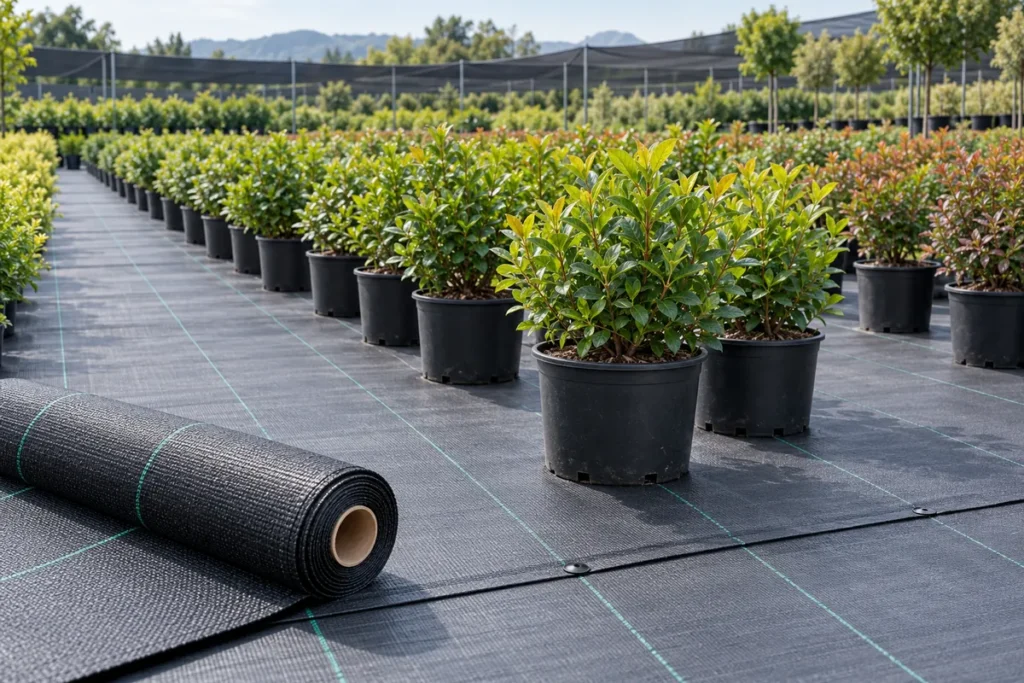
Consider a container nursery expanding an outdoor shrub holding area. Pots sit in rows, workers move plants by trolley, and overhead irrigation wets both pots and walkways. The purchasing team needs ground cover that suits this use, with a layout the installation team can maintain.
Map the production beds, access lanes, drains, posts and irrigation lines separately. Identify pedestrian areas and routes used by loaded equipment. Do not assume a fabric suitable beneath stationary pots is approved for vehicle traffic.
Review our weed control fabric product options, then send your site plan and intended use. For a wider project, see orchard and nursery supply applications.
2. Check drainage before comparing fabric grades
A water-permeable fabric does not correct a compacted base or a low spot that holds water. Ask how the proposed product allows water through, what test information is available, and how the prepared surface will drain during normal irrigation.
Oregon State University Extension highlights drainage and clean growing surfaces in nursery management. It also notes that landscape fabric used alone can clog. Remove accumulated leaves and spilled potting material rather than treating the fabric as maintenance-free.
Have the nursery manager confirm grading, base preparation and drainage routes before installation. Ground cover is one part of site management; it is not a guarantee against weeds or plant disease.
3. Specify more than fabric weight
GSM means grams per square metre. It describes mass per unit area, but does not by itself establish tear resistance, water flow or outdoor service life. Two products with the same stated GSM can have different constructions.
- Material and construction: identify the polymer, woven structure, colour and marking lines required.
- Dimensions: specify width, length and weight with agreed tolerances.
- Performance: request relevant strength, water-permeability and UV-exposure information, including test methods and conditions.
- Use limits: confirm handling, fixing, cleaning and traffic requirements for the offered grade.
Ask for evidence behind any durability claim. A stated UV-test duration should not be converted directly into a guaranteed number of years in your climate.
4. Plan a 600 m² order by cuts, not area alone
Hypothetical planning example: a rectangular bed measures 30 m by 20 m. Assume a 2 m × 100 m roll and 0.10 m side overlaps, with strips running the full 30 m and no end joints. These are calculation assumptions, not confirmed stock sizes or installation recommendations.
Step 1 — Count full-length strips
Ten strips cover 10 × 2 − 9 × 0.10 = 19.1 m of width, which is too narrow.
Eleven strips cover 11 × 2 − 10 × 0.10 = 21 m. The outer edge is trimmed to the 20 m bed width. This layout therefore needs eleven 30 m strips.
Step 2 — Check what each roll can yield
A 100 m roll yields three complete 30 m strips and a 10 m remainder. Three rolls provide nine full strips; four rolls provide twelve.
In this example, four rolls are needed to obtain eleven unjoined strips. The nominal area calculation, 600 ÷ 200 = three rolls, misses the overlap and cutting constraints.
The eleven cut strips contain 660 m² of fabric before edge trimming. Four purchased rolls contain 800 m²; before edge trimming, the unused lengths are one 30 m strip plus four 10 m ends. Keep usable remnants in the material plan.
Different roll widths, strip directions or approved joints may change the result. The final plan must account for actual overlaps, anchoring, edge returns, obstacles and drains. Ask your installer to approve it before turning the estimate into an order.
5. Approve a sample before the bulk shipment
Use a sample of the proposed grade to check handling, markings and water movement over your prepared base. Inspect cut edges and trial the intended fixing method. A small site trial helps identify practical issues but does not establish long-term UV life.
Record the approved sample reference alongside the written specification. Agree incoming checks for roll labels, quantity, dimensions, visible defects and relevant test documents. For distributors, keep different widths or grades on separate order lines so stock can be identified accurately.
Confirm MOQ, lead time, roll packing, gross weight, shipment destination and quotation validity for the actual order. Compare prices on equivalent specifications and delivery terms.
Questions from nursery ground-cover buyers
Is heavier weed control fabric always better?
No. Weight is one specification. Compare construction, strength information, water movement, intended traffic and exposure conditions. Select the grade against the site requirements and agreed evidence.
Can plastic mulch film replace nursery fabric?
They should not be treated as interchangeable. Agricultural mulch film is commonly specified for crop beds, while woven nursery ground cover is selected around container layouts and its intended water movement and handling. Confirm the correct product for each area.
Can seedling trays be included in the enquiry?
Yes. List seedling trays separately with cell count, tray dimensions, material requirements and quantity. Ask for a combined packing and shipment proposal rather than assuming every product shares the same MOQ.
Request a nursery weed control fabric quotation
Send ZHINONG CLOUD your bed dimensions, location and preferred roll sizes. We can discuss supply options and the specification needed for a written bulk quotation.
Copy this enquiry checklist
- Country and delivery destination:
- Nursery area and bed dimensions:
- Irrigation, drainage and traffic:
- Required material, construction and GSM:
- Roll width, length and quantity:
- Sample, test information and packing requirements:
ZHINONG CLOUD
Xuzhou Zhinong Cloud Supply Chain Management Co., Ltd.
Email: dongren122@znyglob.com
Phone / WhatsApp: +86 15940818958
Prefer a form? Send your nursery purchasing requirements.