WHOLESALE PURCHASING · DRIP IRRIGATION
Buying drip tape in bulk starts with a comparable specification. A price per roll says little until diameter, wall thickness, emitter spacing, flow and roll length are clear.
This article helps importers, agricultural distributors and commercial growers prepare a drip tape wholesale enquiry and check the offer before ordering.
The quick purchasing checklist
- Application: crop, row length, soil and water source.
- Product: diameter, wall thickness, emitter spacing and rated flow.
- System: operating pressure, filtration and connection details.
- Order: roll length, quantities by SKU, packing and destination.
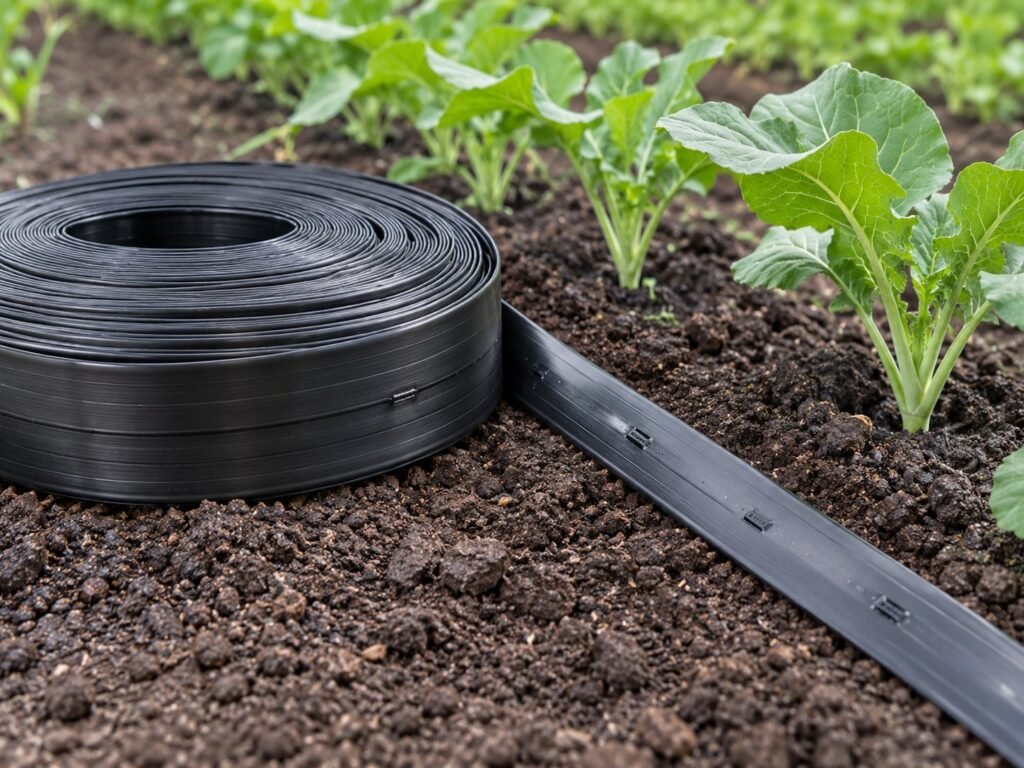
1. Start with the field and water supply
Tell the supplier what you grow, where the field is located and how long each irrigation row will be. Include bed width, row spacing, elevation changes and the number of rows operating together.
Identify whether the water comes from a well, reservoir or another source. Share available pressure, pump capacity and any water-quality report. These details give an irrigation designer a basis for checking the tape, filters and zone layout together.
For our supply scope, see drip tape product specifications and open-field irrigation applications.
2. Specify diameter and wall thickness clearly
State the nominal diameter and confirm the matching connectors. If you request 16 mm drip tape, identify the connection dimensions and fitting type rather than assuming every fitting marked 16 mm is interchangeable.
Give wall thickness with its units and agreed tolerance. Suppliers may quote millimetres or mils: 1 mil equals 0.0254 mm. For example, 8 mil converts to 0.2032 mm; rounding and the accepted production tolerance still need to be stated in writing.
Wall thickness should reflect installation, handling and intended use. A thicker wall alone does not establish a guaranteed number of seasons. Ask for the selected product grade and written service conditions.
3. Compare emitter spacing and flow at a stated pressure
Emitter spacing is the distance between water outlets along the tape. Choose it with the crop, soil wetting pattern and irrigation layout. Changing spacing also changes the water demand per metre.
Request emitter flow in litres per hour at the stated test pressure. Also ask for flow per 100 metres and a product-specific flow-versus-pressure curve. Confirm whether the offered tape is pressure compensating; do not infer this from the diameter or wall thickness.
A simple flow comparison
Illustration only: if each outlet delivers 1 L/h at its rated pressure:
- 20 cm spacing: about 5 outlets per metre, or 500 L/h per 100 m.
- 30 cm spacing: about 3.33 outlets per metre, or 333 L/h per 100 m.
These are approximate nominal totals. They do not account for pressure loss, elevation or outlet variation and are not a maximum-run-length recommendation.
Penn State Extension explains why spacing, flow, wall thickness and pressure characteristics should be considered together. Use the supplier’s data for the specific tape being quoted.
4. Confirm pressure, filtration and flushing requirements
Ask for the recommended operating-pressure range, the conditions behind any maximum lateral length and the required filtration grade. Agree the units for filter rating and check that the recommendation matches the water source.
Include suitable pressure regulation, gauges and access for flushing in the system discussion. The University of Georgia drip-irrigation checklist recommends checking pressure and flow against equipment requirements and inspecting lines for leaks or blockages.
Request written compatibility information for any planned fertigation. An irrigation specialist should confirm the final hydraulic design and operating procedure for your site.
5. Compare roll length, packing and landed scope
Compare equivalent lengths and specifications before comparing prices. A lower price per roll may reflect a shorter roll or a different grade.
- Rolls: metres per roll, length tolerance and roll count.
- Identification: product code, batch reference and label language.
- Packing: wrapping, core details, package dimensions and gross weight.
- Commercial scope: currency, price basis, destination and agreed delivery terms.
Ask the supplier to confirm MOQ, lead time, sample arrangements and quotation validity for your actual order. Keep different diameters, thicknesses and emitter combinations on separate order lines.
6. Approve a reference before the bulk order
Record the approved sample and written specification together. Agree what will be checked before dispatch and on arrival, including labels, roll quantity, dimensions, visible condition and relevant flow-test information.
Ask how joints or splices are declared and how nonconforming material will be documented. This creates a clearer acceptance process for both your purchasing team and the supplier.
Questions from drip tape buyers
Is 16 mm drip tape suitable for every project?
No. Diameter is only one part of selection. Row length, elevation, flow, pressure and connection requirements must also be checked against the offered product data.
Should I choose the closest emitter spacing?
Not automatically. Spacing should suit the crop and soil wetting pattern. Closer outlets can increase total flow demand, so the pump, pipes and zone layout need to be considered.
Can I include mulch film in the same enquiry?
Yes—send a separate specification and quantity for each item. Review agricultural mulch film options and discuss packing and shipment arrangements for the combined requirement.
Request a drip tape wholesale quotation
Send your crop, destination, row length, water source and target tape specification. ZHINONG CLOUD can discuss supply options and the information needed for a written quotation.
Your enquiry in one message
- Crop and country:
- Row length and elevation:
- Diameter and wall thickness:
- Emitter spacing and flow at rated pressure:
- Water source and filtration:
- Metres per roll and number of rolls:
- Destination and packing requirements:
ZHINONG CLOUD
Xuzhou Zhinong Cloud Supply Chain Management Co., Ltd.
dongren122@znyglob.com
Phone / WhatsApp: +86 15940818958
Prefer a website enquiry? Send your bulk purchase requirements.